

Work
Shrotavya
Immersive research to understand the employment challenges faced by deaf and hard-of-hearing people
Background
Many of us, “the hearing population” are knowingly or unknowingly unable to hear the voices around us. In the world of equal opportunities, people with disabilities get less attention and struggle to find employment in mainstream jobs. India recorded a 63 million Deaf population in 2021, and according to Centrum Foundation Survey, India has limited opportunities for deaf and hard-of-hearing people.
“Shrotavya” is a Sanskrit word meaning ‘to be heard’, and this project focuses on India’s Mumbai and Pune-based deaf communities trying to find their place to secure a job in the market. I have leveraged design thinking and research capabilities to uncover the pain points, needs and aspirations along with many other aspects of the experience, for our deaf and hard-of-hearing friends.
The challenge
The 2020 Pandemic has had a significant impact on deaf and hard-of-hearing people. Many lost their jobs and had to return to their native lands. Those without options still have difficulty getting and securing a job.
The goal is to understand the employment challenges and factors contributing to the difficulty our deaf and hard-of-hearing population faces in the mainstream hiring market. It will help us to understand and bridge the possible gaps to create a better world.
Key objectives
- Understand the journey of deaf and hard-of-hearing people finding and securing a job.
- Learn the difficulties and pain points they face in finding and securing the desired job.
- Uncover the challenges and needs they face in these circumstances.
- Find out the available jobs or job sectors catering to the deaf and hard-of-hearing community.
- Find employment agencies, NGOs and institutions that work specifically for the deaf and hard-of-hearing people.
Methodology and Process
The Stanford Design School (d.school)‘s non-linear and iterative design thinking methodology was a valuable tool in my research work due to its ability to handle underlying complex problems effectively. Its user-centred approach enabled me to gain a comprehensive understanding of the underlying pain points, needs and behaviours of the people. This methodology’s structured and collaborative approach helped me to empathise and define the problem statements and needs in an effective way.
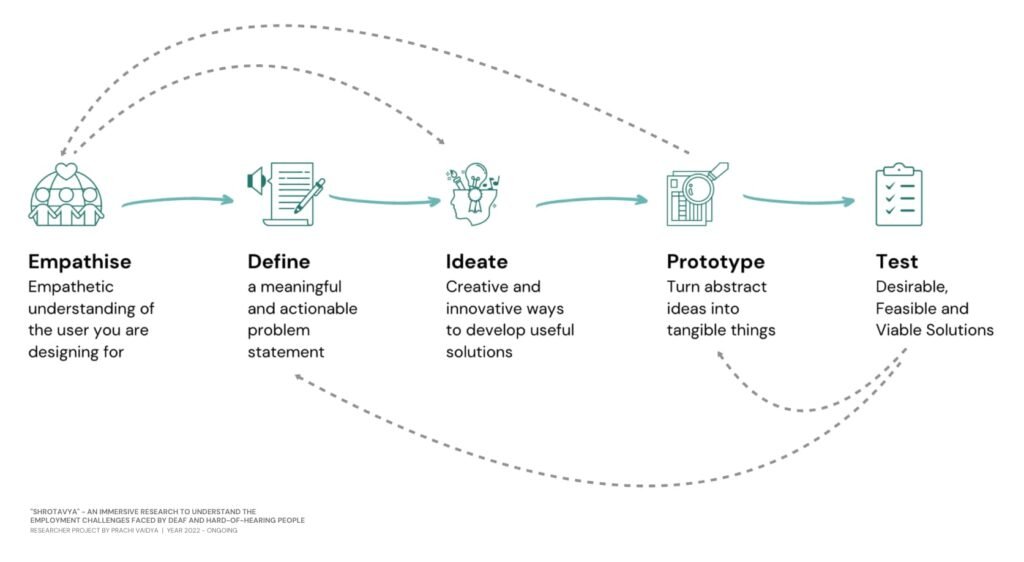
Design Process
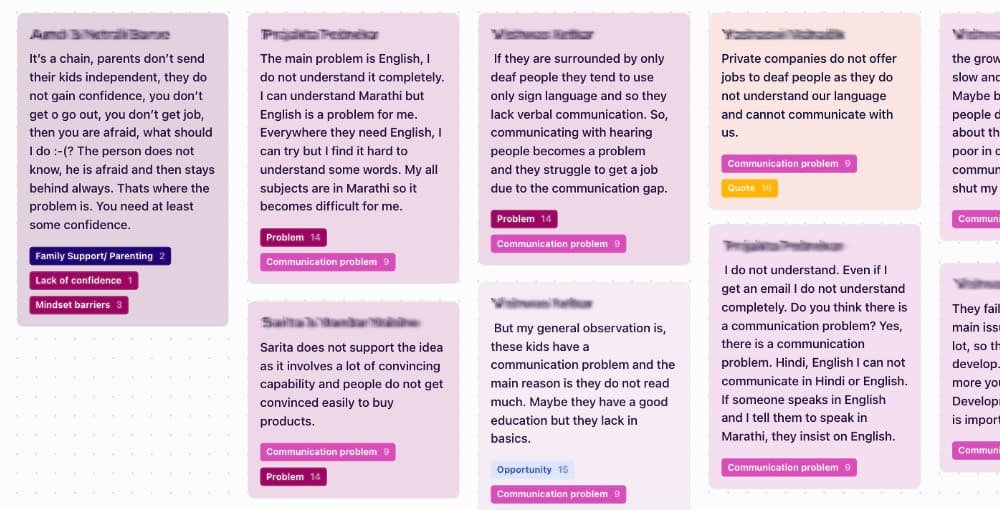
To communicate with the participants, I used Indian Sign Language and lip reading. The interviews were eye-opening and gave valuable insights into each participant’s frustrations, pain points, and aspirations. I used the Dovetail app for analysing and synthesising the data following the interview.
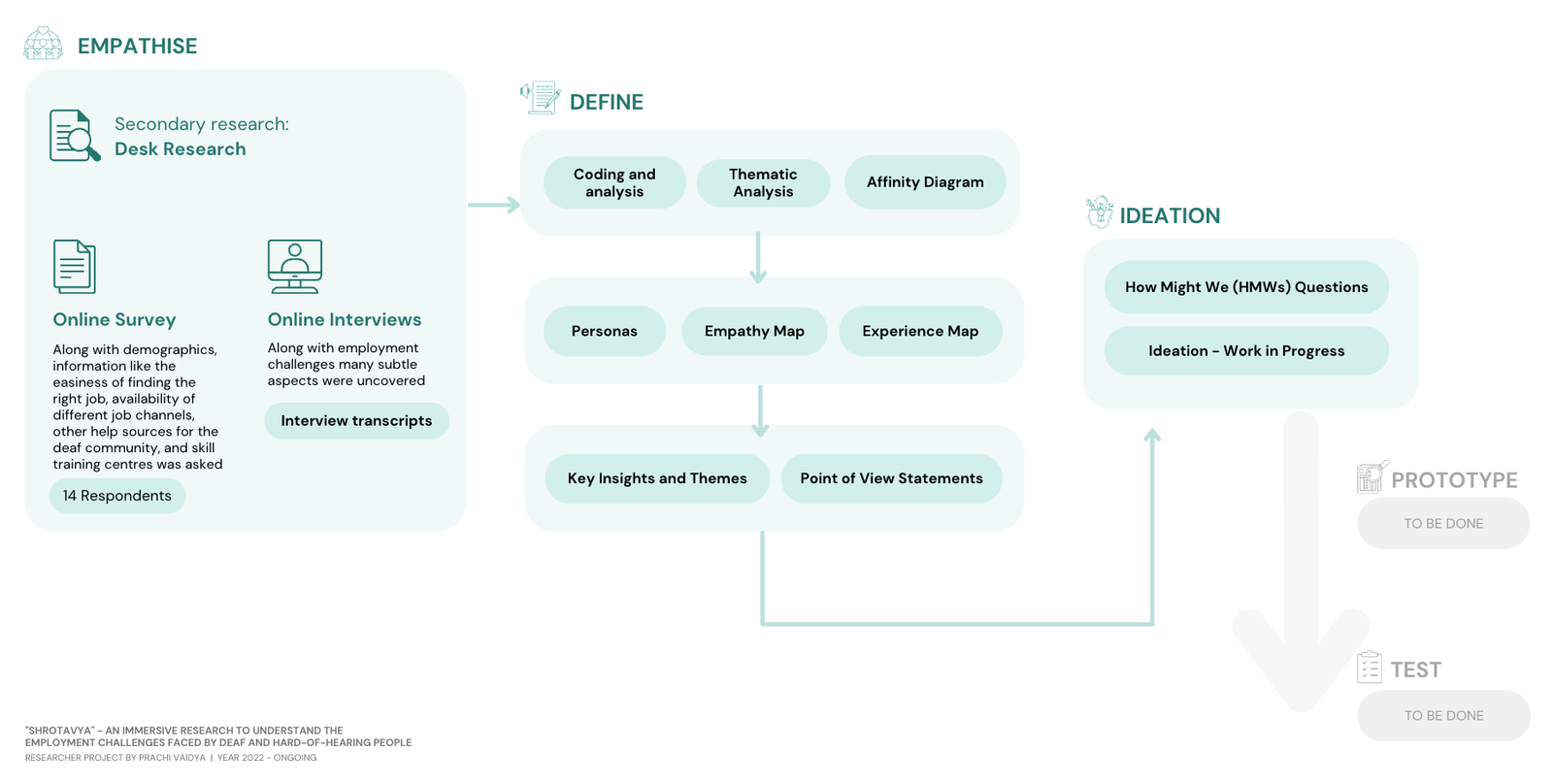
Research stage: Empathise
The project’s initial stage applied design thinking methodology to empathize with the deaf population’s needs, utilizing online surveys and one-on-one interviews. Desk research provided insights into current discussions, while the online survey results touched briefly on the employment challenges faced by the deaf and hard of hearing. The semi-structured interviews delved deeper into personal stories, aspirations, and pain points, revealing opportunities for new areas of focus and desired solutions.
Some of the key outcomes are featured below:
Thematic Analysis
Thematic analysis is a great way to immerse into the interview data and identify patterns and themes.
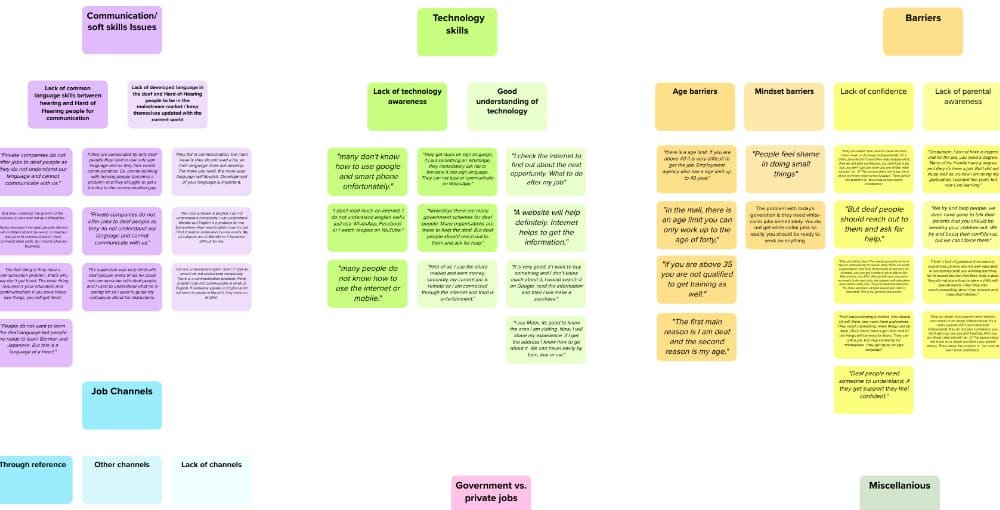
Affinity Diagram
The thematic analysis led me to 7 major themes shown in the affinity diagram. The majority of participants lacked communication, language and technology skills.
Research stage: Define
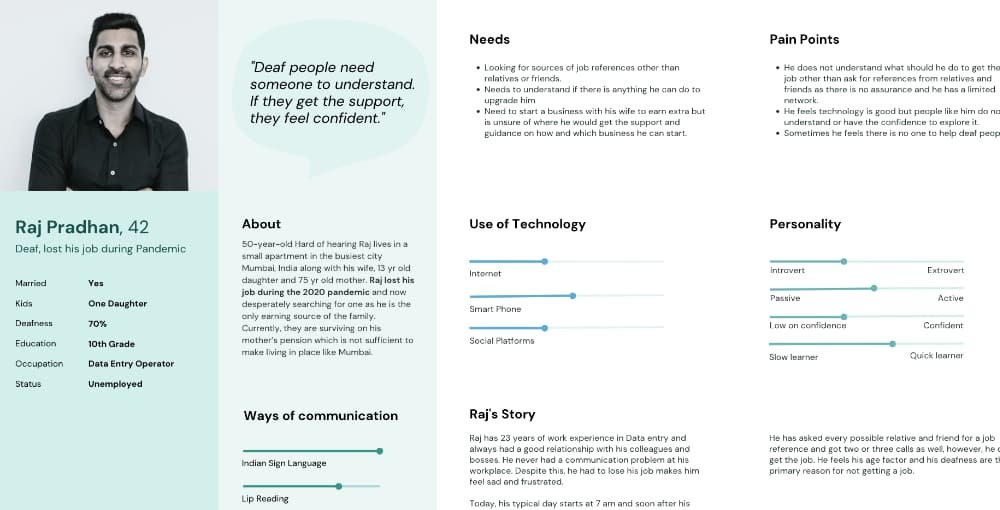
Personas
Combining all the data from the online surveys, interviews & insights from thematic analysis and affinity diagram, I created a persona of a deaf person.
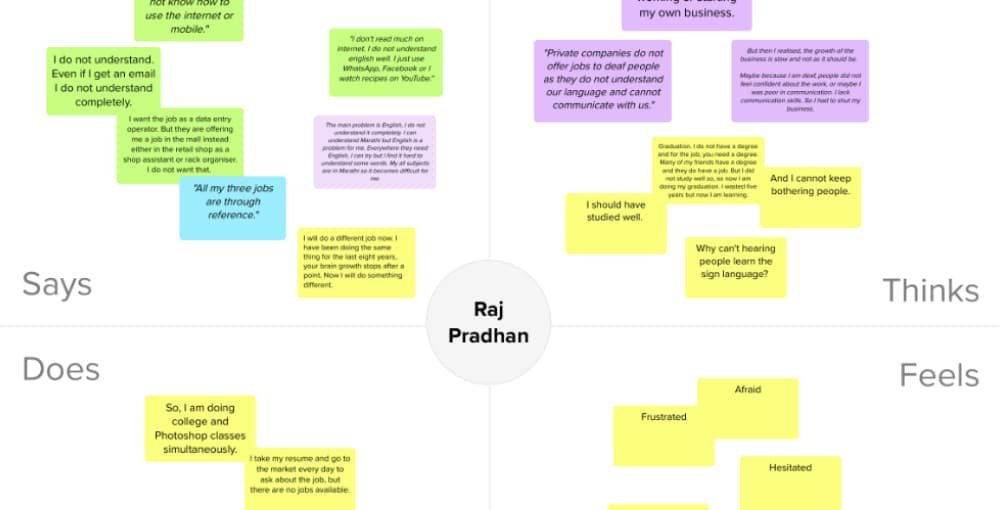
Empathy Map
To empathise more with the persona, I developed an empathy map and tried capturing the persona’s needs, gains and aspirations.
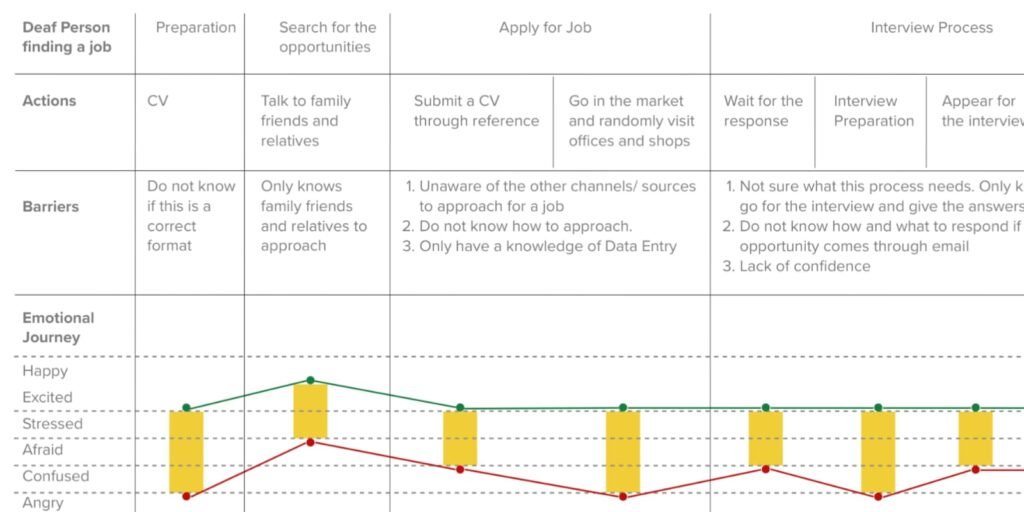
Experience Map
While constructing an experience map, I essentially took a broad perspective and focused on the experience I wanted to examine.
The example given covers a deaf persona’s journey to secure a job, providing a comprehensive view of their experience both within and outside of the context of job searching.
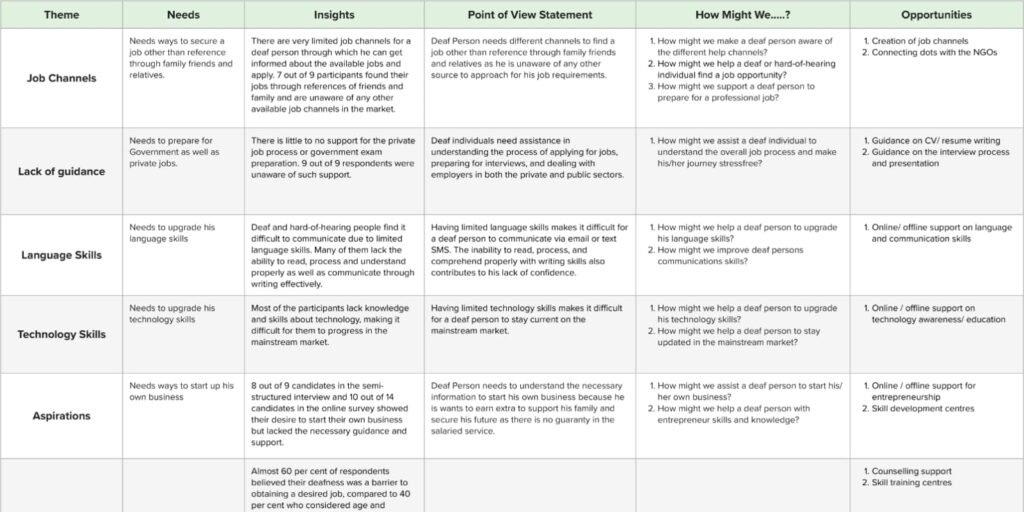
Problem Statement and HMWs
Data synthesis led the way to many themes such as job channels, technology and communication skills, lack of guidance, and barriers. Based on each theme and need, I developed a point of view statement making way for How Might We questions and highlighting the possible opportunities.
Conclusion and the way forward
Conclusion
This research aimed to uncover the reasons behind the difficulty that deaf and hard-of-hearing people face when seeking employment. In addition to the initial employability challenges, the study discovered additional factors such as low literacy rates, limited awareness of technology, and lack of confidence.
The study also found that mindset barriers exist among deaf individuals and their parents, such as a reluctance to take on blue-collar jobs, especially if they come from higher middle-class families, and overprotective parenting that impacts the individual’s ability to function independently. Further research by experts is needed to address these issues effectively.
The Way Forward
The next steps of this study involve connecting with institutions, NGOs and Social workers who are tirelessly working for PWDs (Person With Disabilities) and deaf communities for a better understanding of the issues & concerns they share for the deaf community, parents of deaf individuals on their view and perspectives on raising their child, and entrepreneurs to understand their concerns, issues while hiring deaf individuals.
This will give us the entire picture of the system involved in a deaf individual’s life and map the possible gaps.
Related keywords:
Inclusive research, User research, Generative research, Design Thinking, Sign language, People with Disabilities, PWD,